
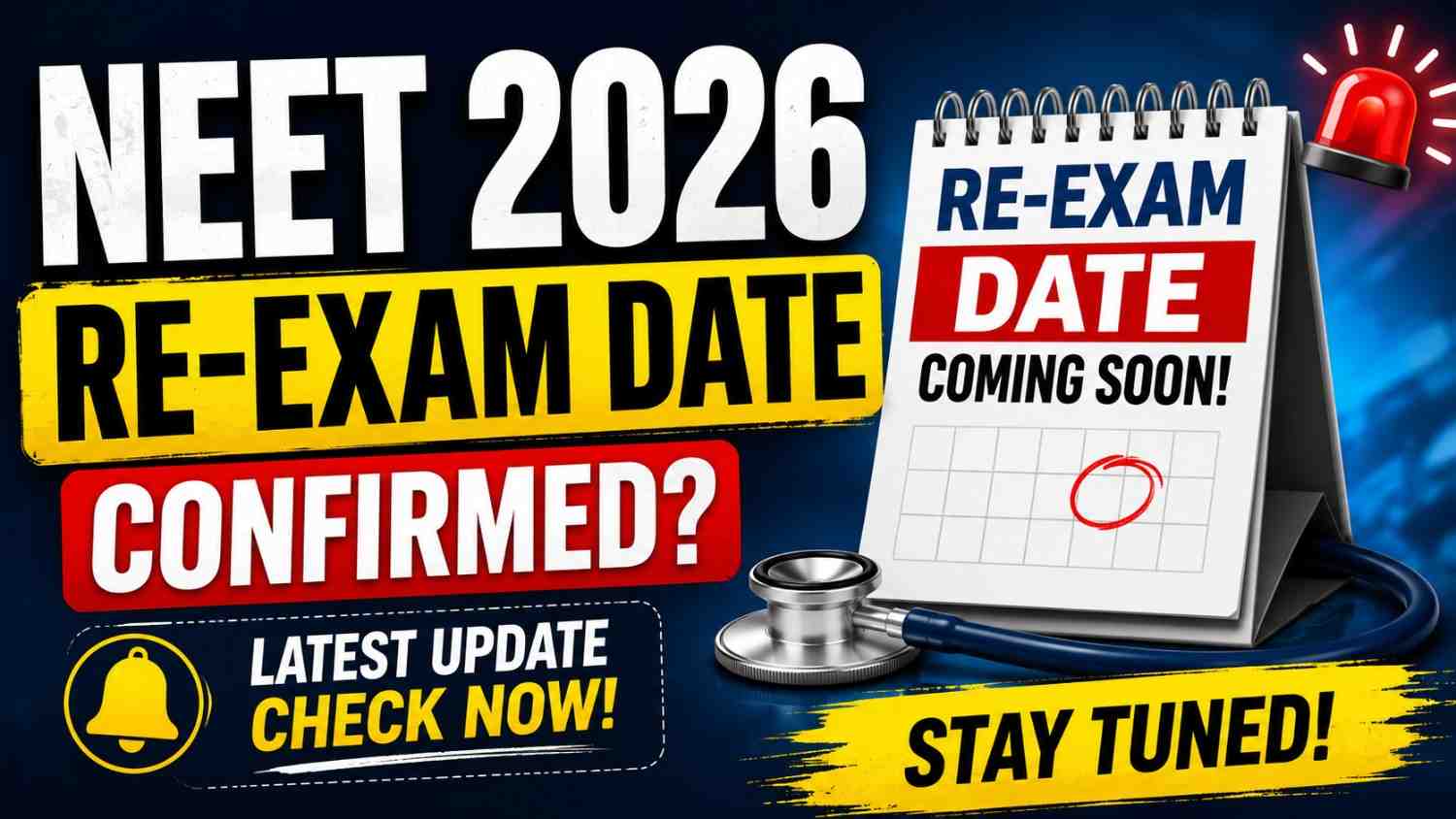
Navigating the high-stakes world of medical entrance exams in India is rarely a smooth ride, but recent announcements have added an entirely new layer of complexity for aspirants this year. Following official updates from the Ministry of Education and the National Testing Agency (NTA), major structural overhauls are reshaping how the National Eligibility cum Entrance Test (NEET-UG) handles irregularities, exam delivery, and student safety.
If you are trying to verify the exact neet 2026 re-exam date, make sense of the sudden shift in exam formats, or adjust your study schedule to protect your hard-earned scores, this breakdown covers everything you need to know.
Table of Contents
The Official Timeline: NEET 2026 Re-Exam Date and Details
Following thorough investigations into exam irregularities and logistical disruptions earlier in the session, the Union Education Minister confirmed that the cancelled national-level medical entrance test will be held again on June 21, 2026.
This emergency re-test is designed to ensure absolute fairness across the board, providing a clean slate for millions of medical aspirants nationwide who deserve an uncompromised testing environment.
NEET 2026 Re-Exam Date: Critical Deadlines and Timings
To minimize administrative friction and anxiety, the NTA has streamlined the transition for registered students. Keep these core timeline metrics on your radar to plan your final days of preparation effectively:
- Admit Card Release: Available for download starting June 14, 2026.
- Re-Exam Date: Confirmed for June 21, 2026.
- Examination Window: 2:00 PM to 5:15 PM (IST).
- City Change Window: A 7-day administrative window is open for candidates wishing to modify their preferred examination city.
Crucial Fee Update: Candidates do not need to pay an additional examination fee for the re-test. The NTA will automatically carry forward registration details from the initial session, and fees previously paid for the disrupted exam are slated for structural refunds to avoid penalizing students for administrative changes.
Why Is a Re-Exam Happening?
The decision to execute a nationwide re-test stems directly from systemic vulnerabilities identified in the traditional distribution architecture. A localized question leak in regional hubs like Bihar and Jharkhand during past examination cycles prompted a comprehensive institutional review of how national papers are handled.
To preserve the academic integrity of the medical selection process, a high-level reform committee led by former ISRO Chairman K. Radhakrishnan recommended sweeping operational adjustments. While structural syllabus refinement remains an ongoing discussion in medical education communities to better balance foundational biology with intense technical testing in physics and chemistry, the immediate focus has turned heavily toward secure test administration.
The upcoming June 21 re-test will be conducted in the familiar offline, pen-and-paper (OMR) mode as a transitional measure. However, the NTA has announced a permanent digital shift for subsequent cycles.
The Big Shift: CBT Mode Confirmed for Next Year
While the immediate neet 2026 re-exam date utilizes OMR sheets, the Ministry of Education has confirmed that NEET will permanently transition to a Computer-Based Test (CBT) mode starting next year. This move aims to systematically eliminate the security risks inherent in printing, transporting, and storing physical test papers across thousands of centers.
Moving to a digital environment brings massive shifts to the overall testing dynamic that future aspirants must adapt to:
1. Statistical Normalization
Unlike a single-day pen-and-paper exam, a massive computer-based test must be spread across multiple days and sessions to accommodate over two million applicants. Because different sessions feature distinct question papers, the NTA will implement a statistical normalization formula to balance out varying levels of question paper difficulty across shifts.
2. Multi-Day Scheduling
A digital format means a tighter network of highly secure, verified testing centers. Consequently, the exam window will expand from a single afternoon into a multi-day testing schedule, requiring students to keep track of precise shift timings assigned via their admit cards.
3. Extra Time Allocations
As a buffer for the current transition period, the NTA is granting an additional 15 minutes during the upcoming June 21 re-test to help students complete administrative formalities without stress, stretching the total paper time to 3 hours and 15 minutes.
Tactical Preparation Strategy for June 21
Having your exam timeline reset can feel incredibly disruptive, but it also gives you an unexpected window to patch up weak areas. Winning this second round requires shifting your focus from raw, heavy memorization to sharp, targeted execution.
Master the Revision Loop
With the countdown running toward the late-June test, your daily routine needs to transition away from reading passive text.
- Simulate the 2:00 PM Window: Your body clock dictates your mental clarity. Sit for full-length mock tests strictly between 2:00 PM and 5:15 PM to train your brain to operate at its absolute peak during official exam hours.
- Analyze Your Error Logs: Do not just check your score and move on. Spend an hour dissecting every single wrong answer. Are you losing marks to conceptual blind spots, or are simple calculation errors tripping you up?
- Prioritize High-Yield Chapters: Double down on core areas where questions show up year after year, such as Genetics, Modern Physics, and Chemical Equilibrium.
Managing Academic Burnout
It is completely normal to feel exhausted by the extended timeline. Treat the remaining days as a marathon rather than a frantic sprint. Ensure you maintain a steady sleep cycle and take structured breaks between intensive study blocks. Mental clarity on exam day is just as critical as the number of hours you put into your notebooks.
Syllabus Distribution and High-Weightage Chapters
To maximize your score in the remaining time before the neet 2026 re-exam date, you must allocate your revision hours based on historical weightage. Trying to re-read every textbook cover-to-cover is an inefficient strategy at this stage. Instead, focus heavily on the core pillars of the syllabus.
Physics: The Deciding Factor
Many medical students find physics challenging, which means scoring well here gives you a massive competitive advantage in the final merit ranks.
- Mechanics: Focus heavily on Work, Power, and Energy, as well as System of Particles and Rotational Motion.
- Modern Physics: This is a highly scoring segment. Ensure complete clarity on Dual Nature of Matter, Atoms, and Nuclei.
- Electrodynamics: Practice numerical problems related to Gauss’s Law, Capacitance, and Current Electricity.
Chemistry: Balancing Theory and Numericals
Chemistry requires a dual approach—memorization for inorganic topics and analytical problem-solving for physical chemistry.
- Organic Chemistry: Master Named Reactions and mechanisms, particularly in Hydrocarbons and Alcohols, Phenols, and Ethers.
- Inorganic Chemistry: Do not skip Coordination Compounds and Chemical Bonding. These are direct, time-saving questions.
- Physical Chemistry: Secure your marks in Thermodynamics, Solutions, and Chemical Kinetics by practicing multi-step numericals.
Biology: The Foundation of Your Score
Biology makes up 50% of the total marks, meaning an exceptional score here is non-negotiable for securing a government medical college seat.
- Human and Plant Physiology: These two units carry immense weightage and require deep conceptual understanding.
- Genetics and Evolution: Expect complex, analytical questions from Principles of Inheritance and Molecular Basis of Inheritance.
- Ecology: Though highly theoretical, this unit provides straightforward questions that can rapidly boost your score.
Last-Minute Checklist for Exam Day
When the neet 2026 re-exam date arrives, administrative errors should be the last thing on your mind. Preparing your exam day kit ahead of time will save you unnecessary panic on the morning of June 21.
Documents to Carry
Ensure these are printed clearly and kept together in a secure folder the night before the exam:
- Printed Admit Card: Downloaded from the official NTA portal after June 14, with the self-declaration form filled out where required.
- Passport Size Photographs: Carry at least two additional copies identical to the one uploaded on your application form.
- Valid Photo ID: A government-issued original identification document (Aadhaar Card, PAN Card, or Passport).
Prohibited Items and Dress Code
The NTA maintains incredibly strict security protocols at entry gates. Avoid wearing heavy jewelry, watches, or clothing with large buttons and deep pockets. Opt for light, comfortable clothing and simple slippers or sandals instead of thick-soled shoes to ensure a hassle-free frisking process.
NEET 2026 Re-Exam Date: Frequently Asked Questions
Do I need to register again for the NEET 2026 re-exam?
No. Your registration data from the initial application is automatically carried forward by the NTA. You only need to log into the official portal if you want to modify your test city during the open 7-day window.
Will the June 21 re-test be online or offline?
The June 21 re-exam will be held in the traditional offline, pen-and-paper mode using OMR sheets. The permanent shift to a Computer-Based Test (CBT) format will take effect starting next year.
When will the NTA release the admit cards for the re-exam?
The official admit cards for the June 21 session will be available for download on the NTA application portal starting June 14, 2026.
What is the exact time duration for the upcoming re-test?
The exam runs from 2:00 PM to 5:15 PM (IST). The NTA has included an extra 15 minutes in this session to give candidates ample time to complete OMR sheet verifications and signing procedures smoothly.
Will the difficulty level of the re-exam be higher?
There is no historical evidence suggesting re-exams are inherently harder. The NTA designs papers based on the standardized NCERT curriculum framework, ensuring that the difficulty metric remains consistent with standard national sessions.
While an unexpected schedule change can feel like an unwelcome hurdle, it is vital to view this extra time as an asset rather than a setback. The structural updates introduced by the Ministry of Education are designed to level the playing field, ensuring that your hard work and dedication are protected by a secure testing framework. Keep your head down, refine your error logs, and approach the June 21 test with the confidence of someone who has been given a second chance to claim their spot.


Leave a Comment