
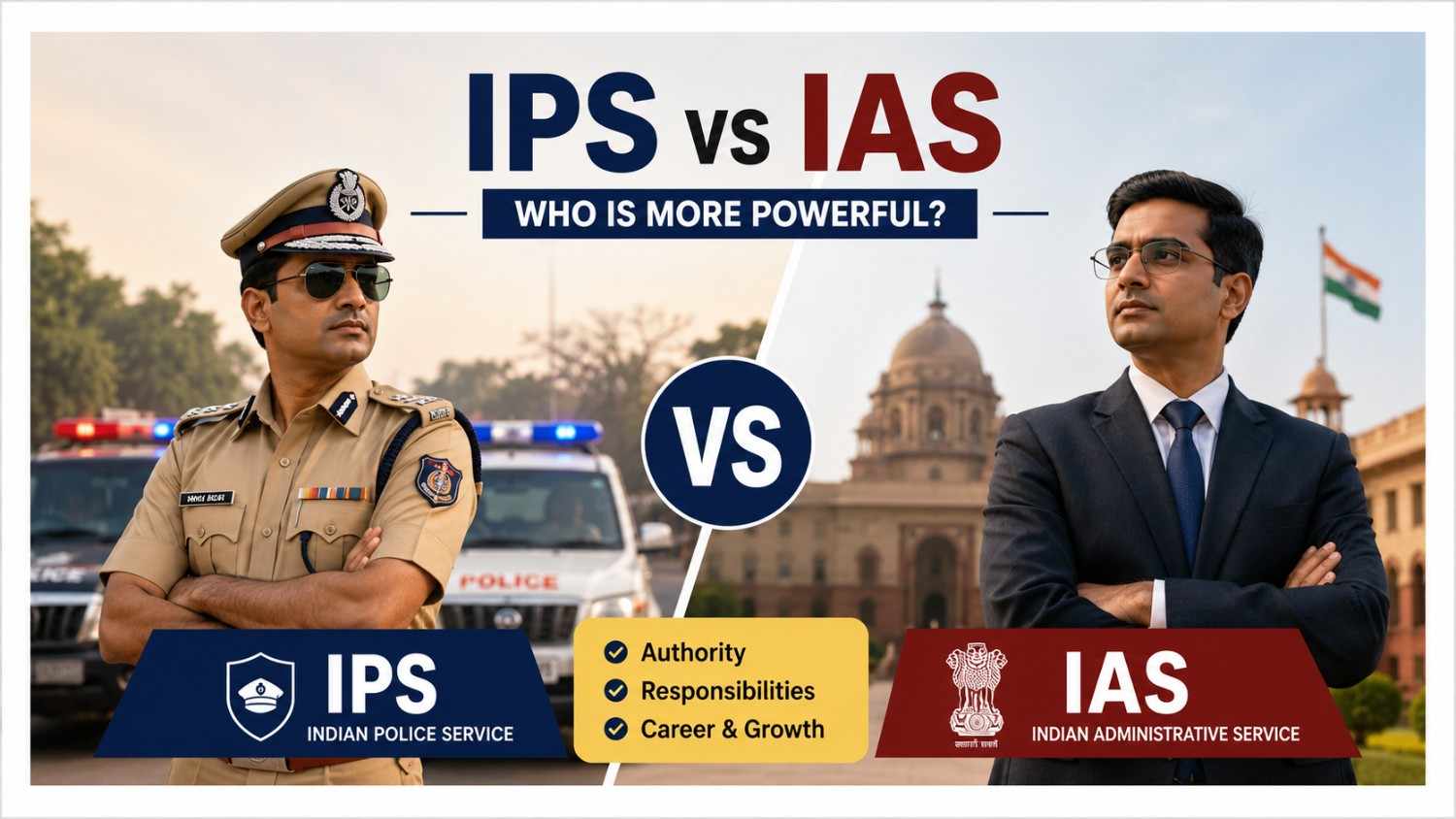
When students start preparing for the UPSC Civil Services Examination, one question comes up repeatedly: IPS vs IAS who is more powerful? Both services are among the most prestigious careers in India and attract lakhs of aspirants every year. However, many candidates remain confused about which position holds greater authority and influence.
The answer is not as straightforward as saying one is superior to the other. The power of an officer depends on administrative structure, responsibilities, government hierarchy, field authority, and career progression.
In this detailed guide, we will compare IPS vs IAS across different factors including power, responsibilities, salary, rank, promotion, lifestyle, and authority. By the end, you will clearly understand which service carries greater power and why.
Table of Contents
What is IAS?
The Indian Administrative Service (IAS) is one of the top civil services in India. IAS officers are responsible for policy formulation, administration, governance, and implementation of government schemes.
An IAS officer acts as the administrative head at district, state, and central levels.
Common roles of an IAS officer include:
- District Magistrate (DM)
- District Collector
- Divisional Commissioner
- Secretary in Government Departments
- Cabinet Secretary
IAS officers play a direct role in policy-making and administrative decisions.
What is IPS?
The Indian Police Service (IPS) is responsible for maintaining law and order, crime prevention, public safety, and internal security.
IPS officers manage police forces at district, state, and national levels.
Common IPS positions include:
- Superintendent of Police (SP)
- Deputy Inspector General (DIG)
- Inspector General (IG)
- Director General of Police (DGP)
- Heads of national security agencies
Their primary responsibility is enforcing laws and ensuring public security.
IPS vs IAS: Basic Difference
| Feature | IAS | IPS |
|---|---|---|
| Full Form | Indian Administrative Service | Indian Police Service |
| Primary Work | Administration and policymaking | Law enforcement and security |
| Cadre Control Authority | Department of Personnel and Training | Ministry of Home Affairs |
| Top Position | Cabinet Secretary | Director General of Police |
| Training Academy | LBSNAA Mussoorie | National Police Academy Hyderabad |
| Nature of Work | Administrative | Police and security management |
Although both belong to elite civil services, their roles differ significantly.
IPS vs IAS Who Is More Powerful?
This is the most searched question among UPSC aspirants.
If we look at administrative hierarchy, IAS officers generally hold more overall authority than IPS officers.
Here is why:
Administrative Control
An IAS officer often supervises and coordinates multiple government departments within a district or state.
For example:
A District Magistrate (IAS) coordinates with:
- Police Department
- Revenue Department
- Education Department
- Health Department
- Rural Development Department
An IPS officer focuses mainly on police administration and law enforcement.
Because of broader administrative authority, IAS officers often have a wider decision-making role.
District-Level Power
At district level:
- IAS officer serves as District Magistrate or Collector
- IPS officer serves as Superintendent of Police (SP)
The SP reports law-and-order matters to the District Magistrate in several administrative situations.
This creates a common perception that IAS officers are more powerful.
Policy-Making Authority
IAS officers can reach high-level policy-making positions such as:
- Chief Secretary
- Union Secretary
- Cabinet Secretary
These positions influence national governance and decision-making.
IPS officers generally focus on police leadership and security administration.
Field Power
On the ground level, IPS officers often appear more powerful.
Reasons include:
- Direct control over police personnel
- Power to enforce law
- Operational command authority
- Handling criminal investigations
- Crisis response leadership
In practical situations, IPS officers exercise visible authority.
So the answer becomes:
IAS officers possess broader administrative power, while IPS officers have stronger operational and law-enforcement power.
Why People Think IPS Officers Are More Powerful
Many people believe IPS officers are more powerful because of the visible nature of their job.
Factors creating this perception include:
Uniform and Public Image
The IPS uniform creates strong public recognition and authority.
Police officers interact directly with:
- Criminals
- Public gatherings
- Security threats
- VIP protection
- Emergency situations
The visibility of their work creates a strong image.
Immediate Action Powers
IPS officers can:
- Order arrests
- Conduct investigations
- Deploy police forces
- Handle riots
- Manage law-and-order situations
People often associate these actions with power.
Command Structure
IPS officers lead thousands of police personnel under their command.
This direct command structure creates a perception of greater authority.
Why IAS Officers Are Considered More Powerful
IAS officers enjoy wider jurisdiction and policy influence.
Major reasons include:
Administrative Authority
An IAS officer can oversee various departments simultaneously.
Their decisions affect:
- Development projects
- Public welfare schemes
- Budget allocation
- District administration
- Governance policies
Top Government Positions
The highest bureaucratic position in India is held by an IAS officer.
The Cabinet Secretary serves as:
- Senior-most civil servant
- Administrative head of Government of India
- Principal adviser to the Prime Minister
No IPS rank exceeds this administrative position.
Broader Career Scope
IAS officers can work in:
- State government
- Central government
- International organizations
- Public sector units
- Ministries
Their career flexibility is generally wider.
IPS vs IAS Salary Comparison
Salary differences between IAS and IPS are not very large because both follow the recommendations of the Pay Commission.
Approximate salary structure:
| Position | Monthly Salary |
|---|---|
| Entry Level IAS | ₹56,100 |
| Entry Level IPS | ₹56,100 |
| Senior Scale IAS | ₹67,700–₹78,800 |
| Senior Scale IPS | ₹67,700–₹78,800 |
| Cabinet Secretary (IAS) | ₹2,50,000 |
| DGP (IPS) | ₹2,25,000 |
Both officers also receive:
- House Rent Allowance
- Travel allowance
- Government accommodation
- Official vehicle
- Staff support
- Security arrangements
- Medical benefits
Salary is almost equal at equivalent levels.
Career Growth: IAS vs IPS
Career progression matters because power often increases with promotions.
IAS Career Path
- Sub-Divisional Magistrate (SDM)
- District Magistrate (DM)
- Divisional Commissioner
- Secretary
- Chief Secretary
- Cabinet Secretary
IPS Career Path
- Assistant Superintendent of Police (ASP)
- Superintendent of Police (SP)
- Deputy Inspector General (DIG)
- Inspector General (IG)
- Additional DGP
- Director General of Police (DGP)
Both careers offer excellent growth opportunities.
Work-Life Balance Comparison
IAS Work-Life Balance
IAS officers often handle:
- Administrative meetings
- Government programs
- Public grievances
- Policy implementation
Work pressure can vary depending on assignments.
IPS Work-Life Balance
IPS officers usually face:
- Emergency calls
- Security duties
- Law-and-order situations
- Crime investigations
- Long working hours
IPS roles can be more physically demanding.
Generally, IAS officers may experience slightly better work-life balance.
Training Difference Between IAS and IPS
Training shapes officers for their future responsibilities.
IAS training includes:
- Public administration
- Economics
- Governance
- Law
- District administration
IPS training includes:
- Physical fitness
- Weapons handling
- Investigation techniques
- Police procedures
- Internal security
IPS training tends to be physically tougher due to field requirements.
Which Service Has More Social Prestige?
Both services command tremendous respect in society.
However:
- IAS officers are often viewed as administrative leaders.
- IPS officers are recognized for courage and public safety.
Social perception varies according to personal interests and regional factors.
Which Service Should You Choose?
Instead of focusing only on IPS vs IAS who is more powerful, consider your personality and career goals.
Choose IAS if you prefer:
- Administrative work
- Policy-making
- Development projects
- Government leadership
- Broader responsibilities
Choose IPS if you prefer:
- Uniform service
- Leadership in action
- Law enforcement
- Crime investigation
- Public security
Interest and aptitude should matter more than perceived power.
Common Myths About IPS vs IAS
Myth 1: IPS officers work under IAS officers all the time
Reality:
IPS officers have independent authority in police administration.
Myth 2: IAS officers always have more field power
Reality:
In law-and-order situations, IPS officers exercise significant operational authority.
Myth 3: Salary of IAS is much higher
Reality:
Pay structures are almost identical.
Myth 4: IPS officers cannot reach high positions
Reality:
IPS officers can become DGP, Intelligence Bureau heads, and leaders of national security agencies.
Final Verdict: IPS vs IAS Who Is More Powerful?
If we compare overall administrative hierarchy, IAS officers generally hold greater institutional and decision-making authority than IPS officers.
But power depends on perspective:
- IAS = broader administrative and policy power
- IPS = stronger law-enforcement and operational power
Neither service is universally superior. Both are pillars of India’s governance system and work together to ensure administration and public security.
If your goal is policy leadership and governance, IAS may suit you better.
If you want command authority, action-oriented work, and public safety responsibilities, IPS can be the right path.
At the end of the day, success in either service depends less on title and more on the officer’s capability, dedication, and impact on society.
Focus keyword used: ips vs ias, ips vs ias who is more powerful


Leave a Comment